DIN 15905-5: 99 dB(A) per half hour, 135 dB(C) peak, duties from 85 and 95 dB(A). Plus noise control for neighbours and practice with limiter and metering.

A concert should have punch, a corporate party atmosphere, and the neighbours should still sleep. So how loud is too loud? For the audience the answer comes from the German standard DIN 15905-5, for the neighbourhood from immission control law and the public order office, for the crew from occupational safety law. This article explains the three directions of protection, the key figures and what an organiser must do and prove. It is practical guidance, not legal advice; what counts is the text of the standards, your permit conditions and your authority's answer.
Noise at events has three addressees, each with its own rules: employees are protected by the Noise and Vibration Occupational Safety Ordinance (LärmVibrationsArbSchV), the audience by DIN 15905-5, residents and the public by immission control law. DIN 15905-5 expressly excludes the protection of people working there from its scope. Anyone planning an event needs all three in view.
The edition that counts is DIN 15905-5:2022-07; it replaces the 2007 version. Part 5 describes measures against a risk to the audience's hearing from high sound emissions of electroacoustic sound systems and explains how the duty of care for public safety can be met. The standard applies to all areas accessible to the audience during an event, for example discotheques, cinemas, concert halls, multi-purpose and exhibition halls, theatres, open-air stages and open-air events, marquees, parades and street festivals. It does not cover emergency announcements, noise made by the audience or pyrotechnics.
The assessment uses the A-weighted equivalent level LAeq at the audience position where the highest value is expected. The limit is 99 dB, formed for each 30 minutes starting on the hour and half hour, for example 18:00 to 18:30 and 18:30 to 19:00. In addition, the C-weighted peak level LCpeak must not exceed 135 dB at any time during the event. If exposure is expected to last longer than 120 minutes, the level averaged over that time must stay below 99 dB, or the audience must be advised to take additional precautions.
Why 99 dB(A) over half an hour? The standard assumes a typical concert visit once a week with about two hours of amplified sound. The value also applies to the loudest spot, so average exposure in the audience is lower.
Measurement starts before the event begins. It uses an integrating sound level meter meeting at least class 2 of DIN EN 61672-1; with mobile systems a function test with a calibrator is due before and after every event. What counts is the audience position with the highest expected level. For the average and the peak level these can be different spots, because mids and highs radiate differently from the subwoofers. As that position is full of people during the show, measurement usually takes place at a substitute point such as front of house. The correction values between substitute point and audience position are determined beforehand with the same system, for example with pink noise, and apply only to exactly that set-up. A measurement log is kept, including organiser, venue and date, the value for each half hour, the instruments, the result of the function test, the measuring points and the correction values, signed by its author.
There are two ways to stay within the limits: a limiter that caps the system, is protected against tampering and is checked regularly for effectiveness, or accompanying measurement on which the operating staff base the level. For this, the current level, the half-hour value and the peak level should be displayed at the mixing position. Barriers or the position of the speakers keep the audience out of the area right in front of the boxes. From 85 dB(A) the audience must be informed, for example on the ticket, by notice, announcement or display board. From 95 dB(A) hearing protection to EN 352 is recommended, and the organiser must provide it.
For planning we recommend: assign responsibility clearly in the contract with the sound provider, decide on limiter or measurement, keep the logs. A limiter is calibrated too, and the calibration is logged. At concerts where the engineer actively rides the level, in our experience the measurement runs at front of house. The correction values described above for the audience position with the highest level apply.
What arrives outside is a different question from what the audience hears. Noise protection for residents and the public is governed by the immission control regulations of the federal states. For open-air events and halls close to housing, the public order office (Ordnungsamt) may, depending on location and event, require a noise protection permit or set conditions, based on the TA Lärm and the state immission control act. The TA Lärm protects the public and the neighbourhood from harmful environmental effects caused by noise; leisure facilities not subject to licensing and open-air restaurants are excluded from its scope. For events, the state's leisure noise guideline (Freizeitlärm-Richtlinie) may therefore also serve as the yardstick. Which rule the authority applies to your event is settled with the public order office. The TA Lärm guide values show the order of magnitude:
Day is 06:00 to 22:00, night 22:00 to 06:00; at night the full night hour with the highest assessment level counts. Short peaks may exceed the guide values by at most 30 dB(A) by day and 20 dB(A) at night. In core, village and mixed areas, in general residential and small settlement areas and in purely residential areas a 6 dB surcharge applies: on weekdays from 06:00 to 07:00 and from 20:00 to 22:00, on Sundays and public holidays from 06:00 to 09:00, 13:00 to 15:00 and 20:00 to 22:00. It may be waived because of special local conditions. For rare events, on no more than ten days or nights per calendar year and not on more than two consecutive weekends, the authority may allow higher values in individual cases if the normal guide values cannot be met even with state-of-the-art noise reduction. The maximum is then 70 dB(A) by day and 55 dB(A) at night; in residential and mixed areas short peaks may exceed these values by only 20 dB(A) by day and 10 dB(A) at night. If rare events from all facilities together cause exceedances at the same location on more than 14 calendar days in a year, this is generally considered unreasonable.
The values apply at the relevant immission point outside the neighbour's house, not at the stage. Between 99 dB(A) at the loudest listener position and, for example, 55 dB(A) by day outside a house in a general residential area lie distance, speaker aiming and bass management.
For employees at the event, the LärmVibrationsArbSchV action values apply, based on the exposure level averaged over eight hours: from the lower action value of 80 dB(A), employees are instructed, hearing protection is provided and health surveillance offered; from the upper action value of 85 dB(A), wearing it is mandatory, surveillance is compulsory, areas are marked and a noise reduction programme is required. There are also action values for the peak sound pressure level: 135 dB(C) lower and 137 dB(C) upper. This applies to employed sound engineers, stage hands and service staff alike. Responsibility lies with each person's employer, so a service provider is responsible for its own staff.
At photon, level is part of every sound design: we agree whether the system is limited or measured and logged at front of house, aim speakers so that the audience hears well and the neighbourhood gets little, and align permit conditions with you. More under sound technology, PA system hire and sound technology Cologne; which system suits which format is shown in microphones, headsets and sound systems. Tell us venue, guest numbers, programme and known conditions via the event enquiry.
Volume can be planned: 99 dB(A) per half hour and a 135 dB(C) peak for the audience, information from 85 and hearing protection from 95 dB(A), the guide values of the TA Lärm or the leisure noise guideline as the yardstick for the neighbours, 80 and 85 dB(A) or 135 and 137 dB(C) peak as action values for the crew. Decide on limiter or measurement early, know the permit conditions, and the evening has punch without endangering anyone. This article is practical guidance, not legal advice; what counts is the text of DIN 15905-5, the immission control law of your federal state, the LärmVibrationsArbSchV and your permit conditions.
Under DIN 15905-5:2022-07, 99 dB(A) is allowed at the loudest audience position, formed for every half hour. The peak level must not exceed 135 dB(C) at any time during the event.
Whoever holds the duty of care for public safety, usually the organiser or venue operator. They must take protective measures and inform the audience from 85 dB(A); under the standard, the organiser provides hearing protection from 95 dB(A).
Yes, unless a tamper-proof limiter ensures that the values are not exceeded. Measurement uses a sound level meter of at least class 2; mobile systems are checked with a calibrator before and after every event.
At the audience position with the highest expected level. The microphone usually stands at a substitute point such as front of house; correction values are then determined beforehand with the same system and applied during measurement.
Depending on location and event, the public order office may require a noise protection permit or set conditions. The basis is the immission control law of the federal state; the yardstick is the TA Lärm or the leisure noise guideline. The TA Lärm names, for example, 55 dB(A) by day and 40 dB(A) at night in a general residential area, 70 dB(A) by day and 55 dB(A) at night for rare events.
From the lower action value of 80 dB(A) hearing protection must be provided, from the upper action value of 85 dB(A) wearing it is mandatory; both are exposure levels averaged over eight hours. The same duties are triggered by peak sound pressure levels: 135 dB(C) for providing protection, 137 dB(C) for mandatory wearing.
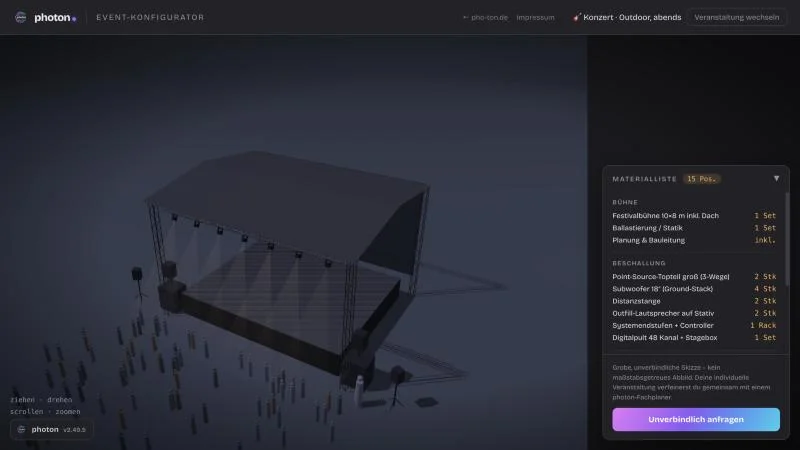 3D configuratorPlan your event in 3DPut together stage, lighting, sound and video yourself – live in 3D, with an equipment list. Then send a no-obligation enquiry.Start configurator →
 360° tourLook inside our warehouseWalk virtually through our warehouse in Wesseling: hall, equipment store, truss and cables – this is where the equipment for your event is maintained and packed.Start tour →
Call us or send us your enquiry. To start, your contact details are all we need – you can add the details afterwards in six short steps.
Christian Fino BeyerManaging Director · Master Technician for Event Technology
5.0 out of 5 stars · 40+ Google reviews


