How much power do lighting, sound and LED walls need? Planning values, diversity factor, cables, generators, and why we test the supply point first.

"Will the socket be enough?" is one of the most common questions before an event, and one of the most important ones. Lighting, sound, LED wall and haze quickly draw more than a domestic socket delivers, and a connection point that looks fine on paper can still fail on the night. This article shows how we at photon plan the power demand, what applies to cables and generators and why we test the supply point first. The figures are planning values, not electrical design: the connection to the house supply is always made by a qualified electrician (Elektrofachkraft).
The basis is the energy demand assessment: all loads are recorded and their ratings added up, including reactive power. Because not everything runs at full load at once, the sum is weighted with a diversity factor per trade, from experience between 0.3 and 1.0 depending on the running order.
For preliminary planning we use photon's own values per device type from our configurator logic (from data sheets):
An abstract example: 8 spots, 8 washes, 2 subwoofers, 4 m² of LED wall and one hazer add up to 3,760 + 4,000 + 2,400 + 9,600 + 200 = 19,960 W, just under 20 kW, before amplifiers and catering. With the diversity factor the demand is lower, but cutting the reserve too fine risks the breaker. Which fuse rating and CEE connection follow is decided by the electrician in the distribution plan.
The second step is recording the on-site conditions, ideally at a site visit: who operates the installation, what condition is it in, are there test reports, do third parties share it, which earthing system, protective measures and fuse ratings are in place, what are the handover points? From this comes the distribution plan with connections, cable lengths, cross-sections and distros: TN-S system from the handover point, load spread evenly across the three phases. Terminal work and generator connections are the electrician's job.
For all supply and connection cables in event technology, heavy rubber-sheathed H07RN-F or equivalent is required; light PVC cables such as H03VV-F are not permitted. Flexible cables should have at least 2.5 mm²; Schuko leads with 1.5 mm² are only allowed up to a plugged length of 25 m at 16 A or 40 m at 10 A. For bonding truss, stage and other conductive structures, 16 or 25 mm² copper has proven itself.
Before connecting to a supply point, an electrician has to test it; nothing goes live without a test and documentation, test basis DIN VDE 0100-600. photon uses a form based on IGVW SQP4, Annex I; it records:
The report covers the house-side supply point. For our own installation behind it, distros, cables and bonding, photon also issues an installer's certificate (Errichterbescheinigung) to SQP4 Annex II: inspection during set-up, testing RCD buttons and isolating devices, measuring protective conductor continuity, insulation resistance (at least 1 MΩ at 500 V DC) and fault protection. Both sheets stay on site with the block diagram.
If the house connection is not enough, generators come in. Portable units up to about 13 kVA work with electrical separation without an earth electrode and are intended for lay users; trailer- or truck-mounted sets are usually set up as a TN-S network with earth rod, which only electricians may do. DGUV Information 203-032, written for construction sites, explicitly applies to event technology too: outdoors at least IP 54, indoors IP 43; exhaust to the open air; refuelling at standstill; protective measures defined by an electrician; RCD test button pressed daily. Surge loads should stay below 50 to 60 percent of rated output; running below 30 to 50 percent damages the engine.
For reliable power planning we need the venue with a contact for the house installation, the existing connections (socket type, fuse rating, location), the running order, catering and other loads not supplied by us, and for open-air events whether mains power exists. We assemble our power distros and CEE cables to match the distribution plan; for dry hire, see the shop category Strom mieten (German). See also Open-air events: what matters in wind and weather and Avoiding technical glitches.
Power is rarely what guests talk about at events, but it is what they would talk about if it failed. Demand calculation with reserve, the right cables and the supply point test take little time and save the evening. All figures here are planning values, not electrical design; connection and design are always done by a qualified electrician. Send us venue, programme and technology wishes via the event enquiry; we plan power, set-up and dismantling and the test.
The sum of all loads, weighted with a diversity factor between 0.3 and 1.0. photon plans with values such as 470 W per spot, 500 W per wash, 1,200 W per subwoofer and 2,400 W per m² of LED wall; the electrician does the design.
Sometimes for small set-ups, usually not for stages with moving heads, subwoofers and an LED wall. The electrician decides the CEE connection; 1.5 mm² Schuko leads are only allowed up to 25 m at 16 A.
The handover point where the mobile installation meets the house supply. Before connecting, an electrician tests condition, voltage, phase rotation and residual current protection to DIN VDE 0100-600; no commissioning without documentation.
230 V line to neutral with a tolerance of 207 to 253 V, 400 V line to line with 360 to 440 V.
Dimmers, LED power supplies and frequency converters produce fault currents the RCD type A, F or B has to match; our test report therefore records rated residual current and type.
When the house connection does not cover the demand or there is none. Outdoors the unit needs at least IP 54; trailer-mounted sets are set up by an electrician.
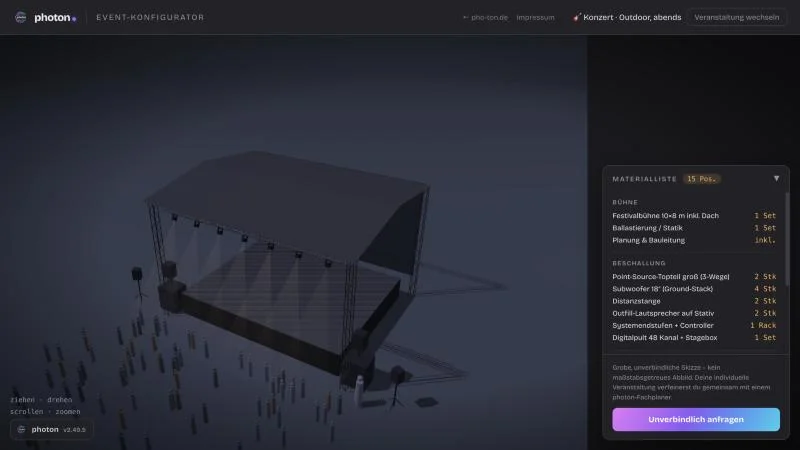 3D configuratorPlan your event in 3DPut together stage, lighting, sound and video yourself – live in 3D, with an equipment list. Then send a no-obligation enquiry.Start configurator →
 360° tourLook inside our warehouseWalk virtually through our warehouse in Wesseling: hall, equipment store, truss and cables – this is where the equipment for your event is maintained and packed.Start tour →
Call us or send us your enquiry. To start, your contact details are all we need – you can add the details afterwards in six short steps.
Christian Fino BeyerManaging Director · Master Technician for Event Technology
5.0 out of 5 stars · 40+ Google reviews


